
Selected Criteria for Effectiveness Unical Sandwich Programme in the University of Calabar, Cross River State-Nigeria
Article Sidebar
Main Article Content
Abstract
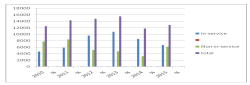
The main purpose of this study was to investigate the extent to which UNICAL Sandwich Programme meets selected criteria of effectiveness in Cross River State, Nigeria.. To achieve the aim of this study, two research questions were formulated to guide this study. Literature related to the variables under study was reviewed according to the research question for the study. Ralph Tyler (Input) evaluation research design was adopted for this study. Secondary data was used in the variables. A total sample of four hundred (400) respondents was randomly selected for the study. The selection was done through the stratified random sampling technique. The main instruments used for the collection of data were records, tables and the questionnaire. The questionnaire was subjected to face validation by the supervisor and experts in Measurement and Evaluation/Research and Statistics and Faculty of Education who vetted the items developed. The reliability estimate of the instrument was established through the test-retest reliability method. The data were collected personally by the researchers with the help of some research assistants, Secondary data were collected directly at the department of Sandwich Programme to know the trend of admission, in-service training, and remedial services. Based on the findings it was recommended among others that the university should ensure that it advertise the programme to the public beyond Cross River State border to show case the programme’s existence, products and the importance, through the print, social and electronic media, this will increase the admission trend.
Downloads
Article Details
Issue
Section

This work is licensed under a Creative Commons Attribution-NonCommercial 4.0 International License.
All articles published in TJESDS are under the Creative Commons Attribution 4.0 International License (CC BY 4.0). This license allows others to:
Share — copy and redistribute the material in any medium or format
Adapt — remix, transform, and build upon the material for any purpose, even commercially
Under the following terms:
Attribution — Proper credit must be given to the original author(s) and source, including a link to the license.
No additional restrictions — You may not apply legal terms or technological measures that legally restrict others from doing anything the license permits.
For more information, visit: https://creativecommons.org/licenses/by/4.0
How to Cite
References
Abdulrahralman, Y. M. (2007), Historical Review of Remedial Education Policies and Programmes in Nigeria.
Adeyemi J. K. (2001). Equality of access and catchment area factor in university admissions in Nigeria, Higher Education, 42, 307-332.
Adeyemi J. K., & Uko-Aviomoh, E. E. (2003). Teaching manpower requirements for effective technical education delivery in Nigerian polytechnics, International Studiesin Educational Administration, 31(3), 16-28.
Adeyemi J. K& Akpotu (2004). Gender analysis of students enrollment in Nigerian Universities. Higher Education, 48, 361-378
Adeyemi, J.K. (2000). Academic manpower needs of Nigerian universities, Higher Education Review. 32 (2) 36-44
Administrative Staff College of Nigeria (ASCON), Jos, Plateau State (2018), Wikipedia.
Adrien, Ditomaso (2015). CNCS of research and evaluation, USA. Developing evaluation instrument based on CIPP models on the implementation of Portfolio assessment.
Aghenta, J. A. (2001). Determinants of educational costs in Ebele J. Maduewesi (ed) Financing of Education in Nigeria Ibadan: The Nigerian Academy of Education,Year Book, 3-4(1) 17-27.
Aghenta, J. A. (2006). Human resources development and planning in Nigeria. Second
Ajayi, K. & Adenija, A (2009). Access to university education in Nigeria proceedings of the 23rd annual congress of Nigeria academy of education.
Ajayi, K., & Adeniji, A. (2008, November). Access to universities in Nigeria. Paper presented at 23rd Annual Congress of the Nigerian Academy of Education, held at the University of Nigeria, Nsukka. American Federation of Teachers, USA. Austin, T. X. National Institute for Staff and Organizational Development (NISOD), University of Texas.
Bernard, A. (2005), National Mathematic Centre, Abuja.
Bernard R.M., Abrami, P.C., Borokhovski, E.,Wade, A., Surks, M., Tamin,R. &Zhang, D.A.(2008). Instructional interventions affecting critical thinking skills and dispositions; a stage one meter analysis review of educational research,78, UO2-1134.
Bill Gate – Founder Microsoft, U.S.A.
Black, J. (2004). Identifying and assisting students at risk: Analyzing the variable UNESCO-IIEP
Canadian Education Institute, Wikipedia (2018).
Cindy , H., & Joellen K. (2007). Ten roles for teacher leaders, vol 65 no. 1 pages 74-77
Creasy, K.L. (2015).Defining professionalism in Education University of northern Colorado 275 Mckee hall, Greenley, Colorado U.S.A. 80639
Crombach, L. J. (1980). Towards reform evaluation San fransico, Josey-Beach.
Dalky & Helmer (1963). Steibach, Manitoba, Canada RSGIBS.
Dan, K S.(2014). Adult Education, Community Development and Counseling, University of Toronto.
David N. 06-04-2013. 6 technology challenges facing education - The Journal. https;//thejournal.com/articles/2013-6-technological-challenges-facingeducation
Ehiametalor, E.T. (2005). Issues and equity, and private sector participation in the deregulation of education: Deregulating the provision and management of education in Nigeria. Jos: The Journal of Nigerian Association for Educational Administrationand Planning,10, 25-30.
Everyone Count International ECI, U.K (2017). Fazalor Raman,Allaama Iqba Open University,Islamabad email fazalaioua@yahoo.com,N.
BB Jamani,Yasmine Ajmal Akhter’Hassan Chisti (2011). Faculty of Education Distinguished Lecture Series, University of Benin, Benin City.24-26
Faludi, A. & Needham, B. (1973). Planning and the public interest Journal of the Royal Rown Planning Institute, 12, 57.
Federal Republic of Nigeria (2004). National Policy on Education. 4th Edition, Lagos: (NERDC).
Federal Republic of Nigeria (2007). Official Gazette. Lagos: Federal Government Press (94), 12-18.
Femi, K. & Dadan, R. S. (2017). Developing evaluation instrument based on CIPP models on implementation of portfolio assessment.
Flannery, M. E. (2010). Top eight challenges teachers face. National Educational Association.
Fredie, S. (1995). America Federation of Teachers.
Gerald, D. E., & Hussar, W. F. (2008). Projections of education statistics to 2008. National Center for Education Statistics USA (NCES), p. 45-48.
Gertrude Mariam chao. On the impact on teachers training on ICT. 2015 policy. Jomo kenyatta universities of agric and technology, department of entrepreneurship and procurement mombasa, keya
Hudson, B. M., Galloway, T. D., & Kaufman, J. L. (1979). Comparison of current planning theories: Counterparts and contradictions. Retrieved
fromhttp://classweb.gmu.edu/erodger1/prls%20531/hudson.pdf
Idaka, E. L. (2006).Examination malpractices among students, nigeria’s journal of education and foundation.
Immegart, G. l. & Pileck, F. J. (1973). An introduction to system for the educational administrator. London: Addison-Wesley Publishing Company.
Incheon Declaration 2015: on education 2030, UNESCO organized world Education Forum hosted by the Republic of Korea.
International Comparative Higher Education Finance and Accessibility (2004). Higher Education in Sub-Saharan Africa. Retrieved from http://www.us.f301.mail.yahoo. com/ym/ComposedMid
Joint Admission and Matriculation Board (JAMB), Abuja, FCT Wikipedia (2018).
Joint Admission Matriculation Board (n.d). Statistics. Retrieved from http://www.jambng.com:8080/jamb/
Jumani, N. B., Fazalur R., Chishti, S. H. & Malik, S. (2014). Teachers training through distance mode in Alama Iqbal Open University. Islamabad, Pakistan.
Kazeem. (2018). Only one in four Nigerians applying to university will get a spot. Africa Quartz.
Keating. (2006). Curriculum Development And Evaluation, Philadephia, Pennsyvania, United State of America.
Kola Adeyemi and nelson Akpotu(2004); gender analysis of students enrolment in Nigeria universities.-springer link Krishnamurti foundation in Ojai, California
Lauritz, B. & Holm-Nelson, L. B. (2001). Lead specialist for higher education, science and technology. Washington DC: The World Bank.
Maricell, G.K. (2009). Department of Biological Sciences, University of Maryland, Baltimore County, Baltimore, USA.
Marwa K. (2017). Teaching and Teacher Education vol. 67 pages 1-560 (Oct 2017). https://www.sciencedirect.com
Nagel, T. (1997). On equity and partiality. Harvard University, USA.
National Board for Examination Measurement (NBEM), Minna, Niger State (2018), Wikipedia.
National Bureau of Statistics (NBS), Abuja, FCT Wikipedia (2018).
National Business and Technical Education (NABTEB), Benin City, Edo State (2018), Wikipedia.
National Examination Council (NECO) Minna, (2018), Wikipedia.
National Open University of Nigeria, Abuja (2018), Wikipedia.
National Teachers Institute (NTI), Wikipedia (2018).
National University Commission (NUC), Abuja Federal Capital Territory, Wikipedia (2018).
Nwangwu, C. C. (1992). Sandwich programmes of Colleges and Universities: Management, problems and prospects. In Afe, J. O. et al (eds.) In-service education of teachers. The Nigerian experience, Asaba: JID Printers (Nig.)
Obasi and Nwaikaire (2014). Comparative study of UNN and UNIABUJA. Management of sandwich.
Ogunyinka, E. K., Okele, T. I. & Adedoyin R. C. (2015). Teacher Education and Nigeria teachers http://www.researchgate.net
Okeke E.A (2009). Annual conference of the Nigeria academy of education held at Nsukka.
Oyakegha, J. Amasingha (2011). An evaluation of the National Open University Education. Programs in South-South Geopolitical zone of Nigeria.
Patrick, F. (2010). Queen Mary University of London, Mile End Road, London.
Edutopia,R. A. (2018), George Lucas Foundation, U.S.A. Seeling Tina, Professor of Management Science and engineering at Stanford
University, California.
Shane Hall (2017). How to use the CIPP model for programme evaluation. Steve Job – Founder of Apple Company, U.S.A.
Stuffle, B. (1969). Evaluation as enlightenment for decision making in Walcott, A. Beaty (ed). Improving, Washington D. C. Association for supervisors and curriculum development.
Uchechukwu, N. (2000). Research Assistant, University of Nigeria, Nsukka.
United Nation Education, Scientific Organizatio (UNESCO), Wikipedia (2018).
West Africa Examination Council (WAEC), Lagos (2018), Wikipedia
William, G. W. (2017) college of Education ,University of Georgia, United State of America.
Zhang, Zeller et al. (2011). Using the CIPP model as a comprehensive framework to guide service learning. Journal of Higher Education Outreach and Engagement. 15 (4) 57-83.